Part A
In this module we talked about different learning theories, and technologies associated with those learning theories. We went through an interactive story on the different learning theories, and I have now posted in my chosen professional learning network (PLN) different responses to these learning theories and technologies. My chosen PLN is edmodo, and the first post is on a behaviourist technology and why I think that the technology I have chosen is a behaviourist technology. Here is a screenshot of my post:
The second post is on cognitivism, and is written about a website that I found to have a high extraneous load. Here is a screenshot of my post:
The third post is on constructivism, and I wrote a note about a constructivist activity that I could do for my major, physics. Here is a screenshot of that post: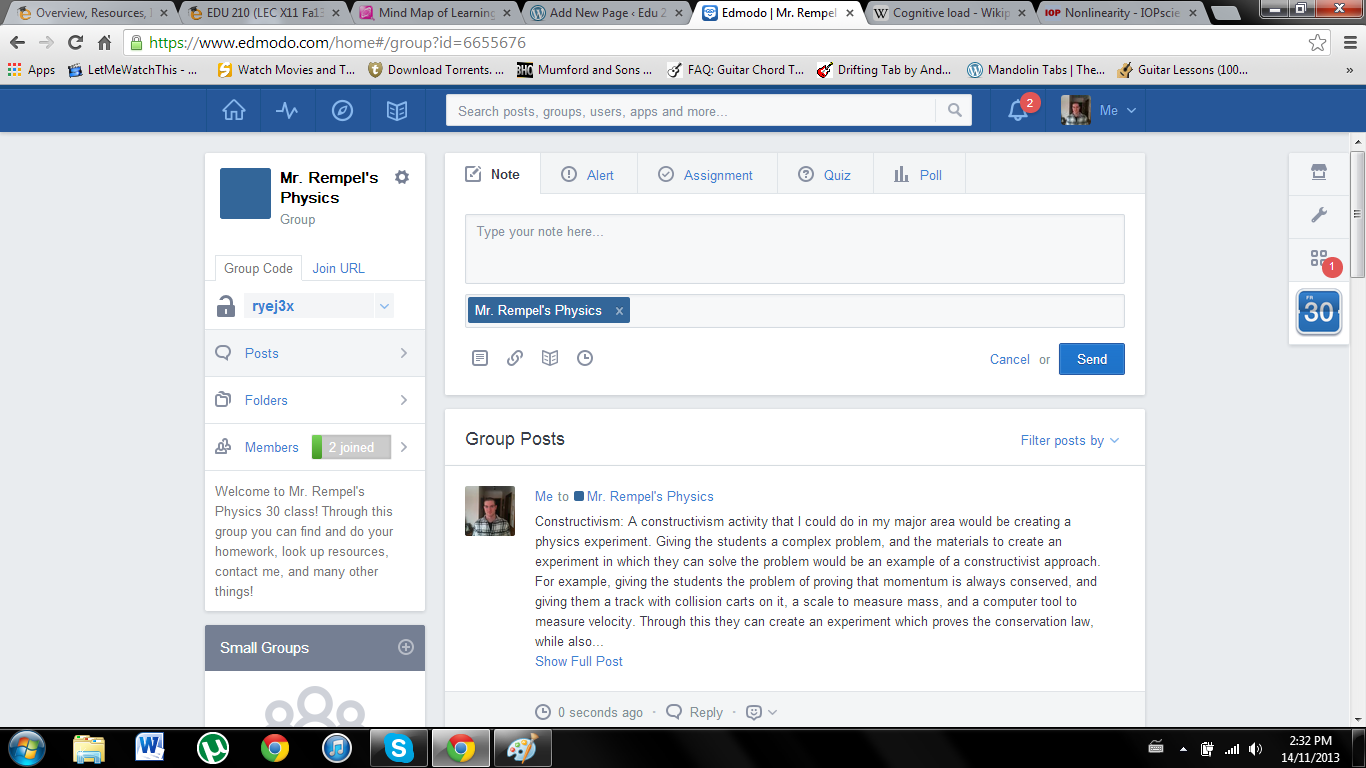
The fourth post is on connectivism, which I wrote about how I connect with constructivism more than connectivism, and why. Here is a screenshot of the post:
Part B
Learning and Technology Theories Reflection:
Of the three learning theories discussed in this module, I think that I identify most with constructivism. Constructivism is the learning theory that I learn best with. I think that I learn best through this way because I can best understand more complex ideas and topics when they are built up from more basic concepts. Repetitive ways of learning such as those associated with behaviourism, with stimulus and responses does not seem to be the most effective way to learn something for me. The social aspects of learning related to cognitivism can be beneficial for me, but I also learn very well on my own, without needing the social aspects of a classroom or other people. Constructivism allows me to build up views that encompass more complex ideas and thoughts by using smaller concepts. This is good for me as I am majoring in physics. To understand the more complex ideas in physics, you need to be able to understand and build upon the smaller blocks and concepts that when put together create the larger view. I learn well through being given a problem to solve and then figuring out all the steps and parts of the question that need to be answered before the overall question can be answered, and constructivism gives me a way to do this.
Three specific ways in which a teacher could use technology to help me learn in through constructivism: One way that a teacher could help me learn this way using technology is by giving me a complex task to complete, such as a research assignment, and giving me access to technological resources, such as ebooks, online journals, and apps that will aid me in finding the information that I need to build up my ideas. Another way could be by giving me a question to figure out, and giving me a way of constructing and using an experiment to find a way to solve the problem. By equipping me with materials to perform different experiments to find different reactions and results, I would be able to use these results to build up my answer to the overall question. A third way in which teachers could implement technology in order to help me learn in this way could be by giving me access to an app that describes and illustrates different aspects of the galaxy. This app would allow me to construct an overall view of the galaxy by investigating smaller details and aspects of different things that make up the galaxy, such as descriptions of planets and orbits. Putting all the information provided on smaller details would give me a way to build a more complex view and theory of the galaxy.
Here are some resources I found useful for developing an understanding of the different learning theories:
 Edu 210